

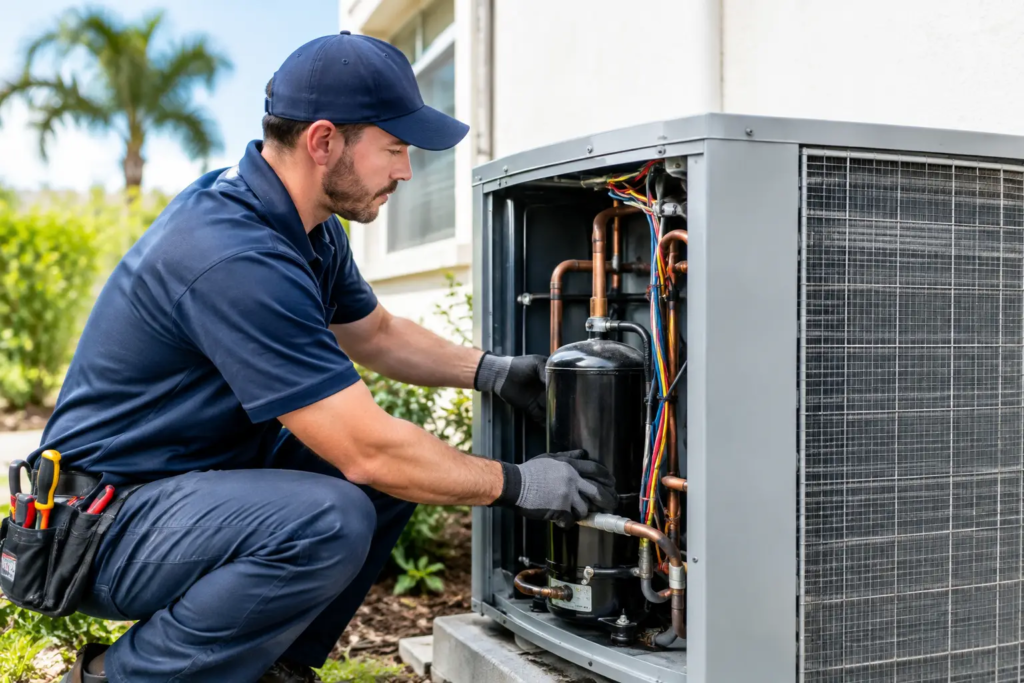
When your outdoor AC unit hums but the house stays warm, the compressor is often the first component people blame. This AC compressor replacement guide explains what the compressor does, how to recognize a true failure, and when replacing it makes financial sense in South Florida’s long cooling season.
The compressor is the heart of a central air-conditioning system. It pressurizes refrigerant so the system can move heat out of your home or business. Because it works under high electrical and mechanical demand, a failed compressor can bring cooling to a stop. But not every no-cool call means the compressor has failed, and replacing one without finding the original cause can lead to another costly breakdown.
What a Failed AC Compressor Looks Like
A compressor failure can be sudden, but it is often preceded by warning signs. Your system may run longer without lowering the indoor temperature, trip the breaker when the outdoor unit starts, or make unusual buzzing, rattling, grinding, or clicking sounds. Warm air from the vents and a fan that runs while the outdoor unit does not are also common symptoms.
Other signs deserve prompt attention:
- The outdoor condenser is excessively hot or repeatedly shuts down.
- Your electric bill rises even though thermostat settings have not changed.
- There is oil around refrigerant lines or connections near the condenser.
- The unit is short-cycling, turning on and off in brief intervals.
- The thermostat calls for cooling, but the condenser makes a loud hum and will not start.
These symptoms can also come from a failed capacitor, contactor, fan motor, wiring issue, low refrigerant charge, dirty coils, or a restricted air filter. Those repairs are usually far less expensive than compressor replacement. A licensed technician should test electrical components, refrigerant pressures, airflow, and the compressor windings before recommending major work.
AC Compressor Replacement Guide: Repair or Replace?
The right choice depends on the equipment’s age, condition, refrigerant type, repair history, and efficiency. In Broward County and across South Florida, an AC system may run for much of the year. That extended workload can make a marginal older system less attractive to repair than it might be in a milder climate.
If your unit is relatively new, otherwise in good condition, and still covered by a manufacturer parts warranty, compressor replacement can be a reasonable path. Labor, refrigerant, electrical components, and cleanup may still create a meaningful out-of-pocket cost, but preserving a newer matched system can be worthwhile.
Replacement of the entire outdoor unit or system is often worth considering when the equipment is 10 to 15 years old, has had repeated refrigerant or electrical issues, or uses an older refrigerant that is increasingly costly to service. A new system can also address comfort problems that a compressor alone will not fix, such as poor humidity control, incorrect sizing, inadequate return airflow, leaking ducts, or uneven temperatures between rooms.
A compressor replacement is not automatically the cheaper decision over time. Installing a new compressor into an aging condenser can leave you with older coils, a worn fan motor, and controls that may fail next. On the other hand, replacing a complete system before its time can be unnecessary if diagnostics show the problem is isolated and the rest of the equipment is sound.
Why Compressors Fail in South Florida
Heat, humidity, salt air near the coast, and near-constant runtime put real stress on air-conditioning equipment. The compressor may fail because it has overheated, lost lubrication, experienced electrical damage, or operated with improper refrigerant pressure.
Low airflow is a frequent contributor. A clogged filter, dirty evaporator coil, blocked return grille, or failing blower can cause the system to run under conditions it was not designed to handle. Dirty condenser coils create a similar problem outside by preventing heat from leaving the refrigerant efficiently. The compressor then works harder and runs hotter.
Refrigerant problems matter as well. Refrigerant does not get “used up” during normal operation. If a system is low, there is usually a leak. Simply adding refrigerant without locating and correcting the leak can leave the compressor vulnerable to another failure. Moisture or debris inside refrigerant lines can also damage a replacement compressor if the system is not cleaned and prepared correctly.
Electrical issues are another major factor. Power surges, loose connections, failing capacitors, and voltage irregularities can cause hard starts and winding damage. In storm-prone South Florida, proper electrical inspection is part of protecting the new equipment, not an optional add-on.
What Professional Compressor Replacement Involves
Compressor replacement is not a homeowner DIY project. Refrigerant handling requires proper licensing and equipment, and the work involves high voltage, pressurized lines, brazing, evacuation, and precise refrigerant charging. An incorrect repair can damage the new compressor, reduce efficiency, create a refrigerant leak, or create a safety risk.
A careful replacement begins with diagnosis. The technician checks power supply, capacitors, contactors, wiring, condenser fan operation, airflow, coil condition, refrigerant readings, and compressor electrical readings. This identifies whether the compressor is truly failed and, just as importantly, why it failed.
When replacement is approved, the technician recovers refrigerant, removes the failed compressor, and installs the correct compatible part. The refrigerant circuit must be protected from contamination. Depending on the cause of failure, this can include replacing the filter drier, addressing acid or debris in the system, repairing leaks, and inspecting metering components.
After the sealed system is repaired, technicians pressure-test it for leaks and evacuate it with a vacuum pump to remove air and moisture. Refrigerant is then charged according to the manufacturer’s specifications, not guessed from a pressure reading alone. The final step is operational testing: verifying temperature split, amperage, pressures, drain performance, airflow, and proper cycling.
Questions to Ask Before Approving the Work
A clear recommendation should give you enough information to make a confident decision. Ask whether the compressor failure has been confirmed through electrical and system testing, what likely caused it, and whether that underlying problem will be corrected during the repair.
You should also ask whether the compressor has warranty coverage, what labor and refrigerant costs are included, and whether the quote includes components such as a capacitor, contactor, filter drier, or leak repair when needed. For an older unit, request a comparison between compressor replacement and replacing the condenser or complete system. The comparison should address efficiency, expected remaining life, warranty coverage, and compatibility with your existing indoor equipment.
For commercial properties, consider downtime as part of the decision. A repair that looks less expensive on paper may be costly if it leaves tenants, customers, employees, or sensitive equipment without dependable cooling during a busy period.
Preventing the Next Compressor Problem
No compressor lasts forever, but regular maintenance can reduce avoidable strain. Change filters on schedule, keep supply and return vents open, and make sure the outdoor unit has room to discharge heat. Do not stack landscaping, storage, or decorative covers against the condenser.
Professional maintenance is particularly valuable before the hottest months. It gives a technician time to clean coils, inspect electrical components, check drain performance, measure system operation, and catch small refrigerant or airflow concerns before they become a no-cool emergency. Homes with pets, construction dust, heavy occupancy, or indoor air-quality concerns may need more frequent filter changes and attention to duct cleanliness.
If your AC stops cooling, turn the thermostat off rather than repeatedly resetting the breaker or forcing the system to run. Repeated restart attempts can increase damage to electrical components and the compressor. A prompt diagnosis is usually the best way to protect your equipment and avoid spending money on the wrong repair.
For homeowners and businesses facing this decision, Premier Cooling LLC can provide a straightforward assessment based on your system’s condition, your property’s airflow needs, and the demands of South Florida heat and humidity. The goal is not simply to get the unit running again, but to help you choose the repair or replacement that keeps your space comfortable and dependable for the seasons ahead.
