

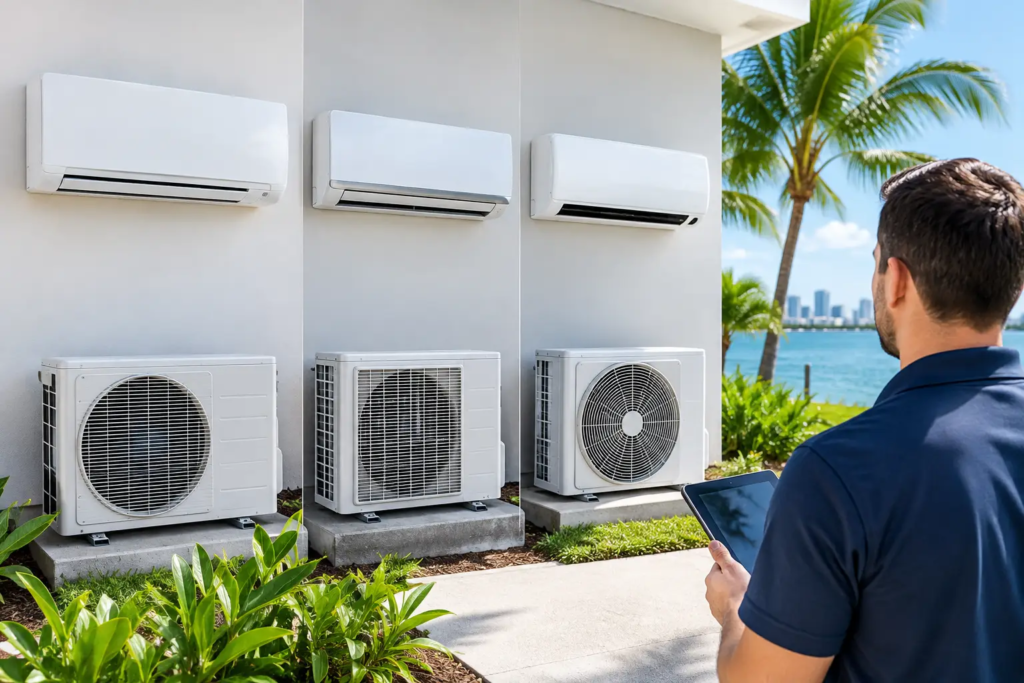
A ductless mini split comparison is most useful when one part of your property is always warmer than the rest. In South Florida, that may be a sun-facing bedroom, a converted garage, a home addition, a server room, or a small office with inconsistent comfort. The right system can solve a targeted cooling problem without extending existing ductwork, but not every mini split is the right fit for every room or building.
What a Ductless Mini Split Does Differently
A ductless mini split has an outdoor condenser connected to one or more indoor air handlers by a small refrigerant line set. Each indoor unit delivers cooled and dehumidified air directly into its zone. Because it does not rely on long duct runs, it can be an efficient option for spaces where ducts are unavailable, impractical, undersized, or too costly to modify.
That direct delivery is a major advantage in Broward County. Duct losses, poor airflow, and hot attic conditions can make certain rooms difficult for a central system to cool. A properly selected mini split gives that room independent temperature control while reducing the need to push your main AC beyond its intended capacity.
However, a mini split is not automatically a replacement for central air. The best choice depends on the size and use of the space, insulation, window exposure, occupancy, existing equipment, electrical capacity, and humidity conditions.
Ductless Mini Split Comparison: Single-Zone vs. Multi-Zone
The first decision is usually whether you need one indoor unit or several.
Single-zone systems
A single-zone mini split pairs one outdoor unit with one indoor air handler. It is often the most straightforward solution for one problem area, such as a primary bedroom that stays warm at night, a garage gym, an enclosed patio, or an office addition.
Single-zone systems are generally easier to size, install, service, and control. They also avoid a common mistake: using one oversized system to try to cover several separate rooms. If doors stay closed, each room typically needs its own planned airflow strategy.
For a single addition or consistently hot room, a single-zone system is often the most cost-effective mini split option. It provides dedicated comfort without changing the rest of the home’s HVAC setup.
Multi-zone systems
A multi-zone system connects multiple indoor units to one outdoor condenser. This can work well for additions with several rooms, small commercial suites, guest areas, or homes without usable ductwork. Each zone can have its own thermostat setting, which helps occupants control comfort based on how each space is used.
The trade-off is complexity. Multi-zone design requires careful load calculations and equipment matching. Outdoor-unit capacity is shared among indoor units, so a system must be selected for realistic simultaneous demand, not just the maximum rating printed next to each air handler.
A multi-zone installation can also be more expensive to repair if the outdoor unit has a problem, because several rooms may be affected. For some properties, separate single-zone systems offer more redundancy and simpler future service. For others, one outdoor unit is the cleaner choice because of limited exterior space or aesthetic concerns.
Cooling Capacity Is Not Just Square Footage
Mini splits are commonly described by BTU capacity, but square footage alone is not enough to choose the right size. A 12,000 BTU system may be appropriate for one 400-square-foot room and inadequate or oversized for another room of the same size.
South Florida cooling loads are affected by afternoon sun, ceiling height, insulation quality, large glass doors, roof exposure, kitchen appliances, electronics, and the number of people using the space. Humidity matters as much as temperature. An oversized system may lower the thermostat reading quickly but cycle too lightly to remove enough moisture, leaving the room cool yet clammy.
Undersizing creates a different problem. The system may run continuously during peak heat, struggle to reach the set temperature, and wear down faster. A professional assessment should consider the entire room rather than relying on an online sizing chart.
Efficiency Ratings and What They Mean for Your Bill
Many ductless systems use inverter-driven compressors. Instead of running only at full output and then shutting off, they can adjust their speed as cooling demand changes. That steadier operation can improve efficiency and support better comfort control.
When comparing models, look at SEER2, the current seasonal cooling-efficiency rating. A higher SEER2 rating can reduce operating costs, particularly in a climate where cooling equipment runs for much of the year. But the highest-rated model is not always the best value.
The price difference between efficiency tiers should be weighed against how often the system will run. A mini split serving a lightly used guest room may not justify the same equipment investment as one cooling a busy home office every day. Installation quality, sizing, maintenance, and air sealing can also have as much impact on real-world performance as the equipment rating.
Indoor Unit Styles Matter More Than Appearance
Wall-mounted air handlers are the most common choice because they are efficient, accessible for maintenance, and well suited to many bedrooms, offices, and living areas. They need an unobstructed path to distribute air, so placement should be planned around furniture, doorways, and room layout.
Ceiling cassette units are more concealed and can distribute air in several directions. They can be a good fit for open rooms or commercial settings, but installation usually requires enough ceiling cavity space and access for service. Floor-mounted units can help where wall placement is limited, while concealed ducted mini split units can serve a small group of rooms with short duct runs.
A less visible unit is not necessarily a better unit. The best indoor style is the one that provides proper airflow, can be cleaned and serviced, and fits the building without creating avoidable renovation work.
Humidity Control Is a South Florida Priority
Cooling and dehumidification go together, but they are not identical. During rainy months and mild-weather periods, indoor moisture can remain high even when temperatures are not extreme. High humidity can make a room feel uncomfortable, encourage musty odors, and contribute to mold concerns in vulnerable areas.
Mini splits can provide excellent humidity control when they are correctly sized and configured. Some models include dedicated dry modes, but that feature should not replace proper system design. Drainage must be installed correctly, refrigerant lines must be insulated, and the indoor unit needs regular filter and coil cleaning to maintain airflow.
For rooms with persistent moisture, such as enclosed patios, laundry areas, or poorly insulated additions, the underlying source of humidity should also be addressed. Leaks, unsealed openings, and inadequate ventilation can overwhelm any air-conditioning system.
Installation Quality Can Make or Break the System
A high-efficiency mini split installed poorly will not deliver the comfort or savings you expect. The outdoor unit needs stable mounting, proper clearance, and a location that allows service access. Refrigerant lines require correct sizing, pressure testing, evacuation, insulation, and protection from damage. Condensate drainage must flow reliably so water does not back up into the indoor unit or wall.
Electrical work is equally important. A mini split needs the correct dedicated circuit, disconnect, and code-compliant installation. For commercial properties, placement and permitting may involve additional considerations, including occupant safety and building requirements.
Licensed and insured technicians should explain where each component will go, what the installation includes, and how the system will be maintained. Clear planning helps prevent surprises after the wall-mounted unit is already in place.
When a Mini Split Makes Sense and When It Does Not
A ductless system is especially useful when you need targeted cooling, are adding conditioned space, or want separate temperature control in a room that central air cannot serve well. It can also be a practical option for older properties without ducts and smaller commercial spaces with different comfort needs across rooms.
It may be less suitable when an existing central system has widespread duct leakage, poor maintenance, or major sizing problems affecting the entire building. Adding a mini split can relieve one room, but it will not correct a failing central AC system, poor whole-home insulation, or drainage issues. In those cases, a complete HVAC evaluation often provides a better long-term answer.
For property owners comparing several options, Premier Cooling LLC can assess room load, airflow, layout, humidity, and energy goals before recommending equipment. That approach helps avoid installing a system that looks right on paper but falls short during a July afternoon.
The best mini split is not simply the biggest unit or the highest efficiency rating. It is the system sized for your space, installed correctly, and maintained well enough to keep your family, tenants, employees, or customers comfortable when South Florida heat puts it to work.
