

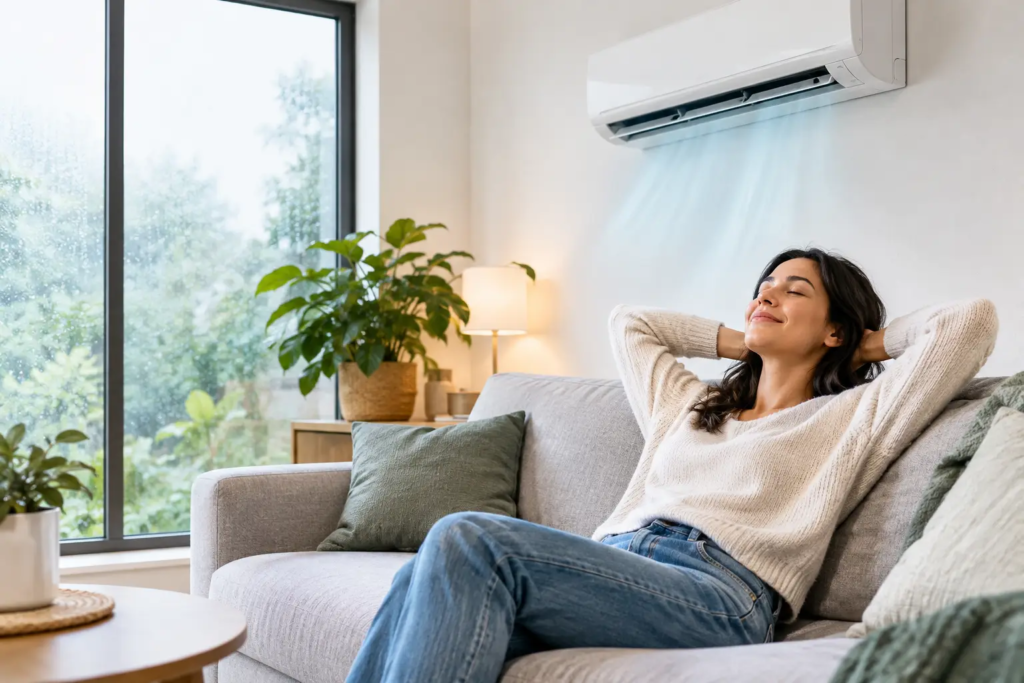
A South Florida air conditioner has a bigger job than simply lowering the temperature. It must remove enough moisture to keep rooms from feeling sticky, protect indoor air quality, and avoid the short cycling that drives up energy use. The best AC features for humid climates address both sensible heat, which changes the temperature, and latent heat, which is the moisture in the air.
That distinction matters in Broward County and throughout Fort Lauderdale, Miami, and West Palm Beach. A system can show 72 degrees on the thermostat while the house still feels damp and uncomfortable. Choosing equipment based only on tonnage or a high efficiency rating can leave homeowners and business owners with an expensive system that does not match the building or the climate.
Why Humidity Changes How an AC Should Be Selected
Air conditioning naturally removes some moisture as warm air passes across the indoor evaporator coil. Water vapor condenses on the coil and drains away. But how much moisture the system removes depends on its runtime, airflow, coil performance, and the size of the equipment.
In a dry climate, rapid cooling may be enough. In South Florida, an oversized AC can satisfy the thermostat quickly, shut off too soon, and leave much of the moisture behind. The result is a cool but clammy home, possible mildew odors, condensation around vents, and uneven comfort from one room to another.
The right system starts with a proper load calculation, not a rule-of-thumb replacement based on the old unit. A licensed HVAC technician should consider square footage, ceiling height, insulation, window exposure, ductwork, occupancy, appliances, and areas where outdoor air may enter. For commercial properties, operating hours, equipment loads, and occupant density also affect the recommendation.
Best AC Features for Humid Climates
Variable-Speed Cooling for Longer, Gentler Cycles
A variable-speed air handler or compressor is one of the most useful features for high-humidity conditions. Instead of operating only at full capacity, the equipment can run at lower output for longer periods when the demand is moderate.
Longer cycles allow more air to move across the evaporator coil, giving the system more opportunity to remove moisture. They also help maintain steadier indoor temperatures, reduce loud start-and-stop operation, and improve airflow to rooms that tend to run warmer.
Variable-speed equipment usually costs more upfront than a single-stage system. Still, it can be a strong investment for households that notice afternoon stickiness, humidity swings, or comfort problems in bedrooms and upper floors. The value depends on correct sizing and installation. Even premium equipment cannot overcome undersized ducts, major air leaks, or poor drainage.
Two-Stage Cooling When Variable Speed Is Not the Right Fit
Two-stage systems offer a practical middle ground. They typically operate at a lower stage for much of the day and use full capacity during severe heat or heavy occupancy. That lower stage can provide longer runtimes and better humidity control than a basic single-stage unit.
For many South Florida homes, a properly sized two-stage system provides a meaningful comfort improvement without the higher equipment cost of a fully variable system. It is also worth considering where budget, electrical upgrades, or existing ductwork make a more advanced setup less practical.
A Thermostat That Can Control Humidity
A thermostat should do more than display temperature. Look for one with indoor humidity monitoring and dehumidification settings. Some models can tell a compatible AC system to continue running at lower capacity or adjust airflow when humidity rises above the selected range.
For most occupied homes, indoor relative humidity is commonly most comfortable around 45% to 55%. The ideal setting can vary based on the building, lifestyle, and how often doors open. A thermostat is not a substitute for a correctly designed system, but it gives homeowners and facilities managers better visibility into a comfort issue that a temperature-only display can miss.
Be cautious with settings that force excessive cooling just to lower humidity. If a thermostat must be set unusually low before the space feels dry, the underlying issue may be equipment sizing, airflow, duct leakage, or the need for dedicated dehumidification.
Enhanced Dehumidification Airflow Settings
Airflow has a direct effect on moisture removal. When air moves more slowly across the evaporator coil, the coil can remove more water vapor. Many compatible variable-speed and two-stage systems offer enhanced dehumidification modes that reduce blower speed when humidity is high.
This feature must be configured carefully. Airflow that is too low can create icing, reduce system performance, and cause equipment problems. A professional installation should verify static pressure, refrigerant charge, drainage, and manufacturer-required airflow settings rather than treating humidity control as a thermostat adjustment alone.
A Dedicated Whole-Home Dehumidifier
An air conditioner is designed primarily to cool. During mild, rainy, or shoulder-season weather, there may not be enough cooling demand for it to remove the moisture a building needs removed. A whole-home dehumidifier solves that gap by drying the air independently of the thermostat setting.
This addition can be particularly helpful for larger homes, waterfront properties, houses that remain closed while owners travel, and commercial spaces with frequent door traffic. It can also reduce the temptation to set the thermostat lower than necessary, which may improve comfort without wasting energy.
A portable dehumidifier can help in a single problem room, but it is not usually a whole-house solution. It needs regular emptying or a drain connection, adds some heat to the room, and may be too small for widespread moisture issues.
Properly Sized Equipment and a Matched Indoor Coil
Correct sizing is a feature in practice, even though it is not printed on a brochure. The outdoor unit, indoor coil, air handler or furnace, refrigerant line set, and controls need to work as a matched system. Mixing components without confirming compatibility can compromise capacity, efficiency, and humidity performance.
Bigger is not automatically better. Oversized systems often short cycle, while undersized systems may run continuously and still fail to keep up during peak heat. A careful load calculation gives the installer a defensible starting point for selecting capacity. From there, the equipment choice should reflect the property’s actual comfort priorities and budget.
Reliable Condensate Drainage and Float Switch Protection
In humid climates, an AC can produce a substantial amount of condensate. That water has to leave the system safely. A properly trapped and sloped drain line, accessible cleanout points, and a float switch are essential protections, especially in attics, closets, and commercial ceiling spaces.
A float switch can shut the system off when a drain backs up, helping prevent ceiling damage, overflow, and costly water repairs. It may feel inconvenient when the system stops, but it is far better than discovering a leak after water has spread through insulation or drywall.
Routine maintenance should include checking the drain pan, clearing the condensate line, and confirming that the safety switch works. In South Florida, this small service step prevents a surprising number of emergency calls.
Corrosion-Resistant Components Near the Coast
Salt air can be hard on outdoor equipment in coastal communities. Corrosion-resistant cabinet materials, protective coil coatings approved by the manufacturer, and regular cleaning can help extend system life. No coating makes equipment maintenance-free, and some products can affect heat transfer if poorly applied. The best approach is to select suitable equipment, keep vegetation and debris away from the condenser, and schedule regular inspections.
Features That Matter, but Do Not Solve Humidity Alone
A high SEER2 rating can lower operating costs, but efficiency does not guarantee strong moisture control. Likewise, UV lights, upgraded filters, and air purification products may support indoor air quality in the right application, but they do not replace source moisture control, drainage maintenance, or adequate ventilation.
Ductwork deserves equal attention. Leaky return ducts can pull hot, humid attic air into the system. Poorly insulated ducts may sweat in humid spaces. Restricted returns and dirty filters can reduce airflow and worsen comfort. Before replacing equipment, a technician should evaluate the entire system instead of assuming the outdoor unit is the only issue.
When to Ask for a Humidity-Focused AC Evaluation
Consider a professional evaluation if your home feels clammy below 75 degrees, you see condensation on supply vents, certain rooms smell musty, or the AC turns on and off frequently. Business owners should also pay attention to humidity complaints from staff or customers, fogged windows, recurring ceiling stains, and uneven conditions across offices or retail areas.
Premier Cooling LLC evaluates the equipment, airflow, drainage, duct condition, and property layout so recommendations fit South Florida conditions rather than a one-size-fits-all package. Licensed and insured technicians can identify whether a repair, maintenance correction, system adjustment, dehumidifier, or replacement is the sensible next step.
Comfort in humid weather should not depend on setting the thermostat colder and hoping for the best. A properly selected and maintained AC system keeps moisture under control quietly in the background, helping your family, tenants, employees, or customers feel comfortable when South Florida heat is at its worst.
